This article 'Managing Technology' is accepted for publication in Teacher (A Magazine of Australian Council of Educational Research); Vol.9 No.3 (2015) 22-23, which talks about how Management of Technology improves productivity within the institution thus facilitates active teaching - learning at K-12 level......
Saturday, April 18, 2015
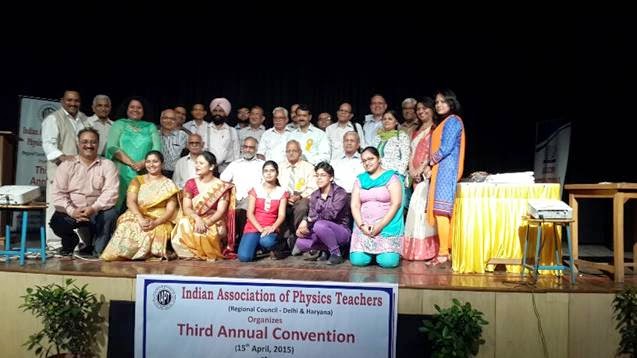
Glimpses of IAPT Convention 2015.....
It was a wonderful learning experience for me to be a part of the organizing committee of this convention at AIS this year. Heartfelt thanks to my Principal Ashok K Pandey for the opportunity and other members of Indian Association of Physics Teachers, Regional Council-1 for their unconditional support to make this event a grand success....
Saturday, January 17, 2015
About thinking: Understanding How We Learn ......
Welcome 2015 !!!!
The article 'About thinking: Understanding how we learn,' which is accepted for publication in Teacher (A Magazine of Australian Council of Educational Research); Vol.9 No.2 (2015) 22-25, talks about ‘Cognitive Tutor’ in science enhancing learning at K-12 Level. It is an application of Cognitive Architecture ACT-R....
Friday, January 9, 2015
Board Special 2015......
Latest Updates on Board Special - 2015
Class - XII
Chapter combinations for tests in January - February 2015 (1 Hr., 25 Marks):
1. Electrostatics and Current Electricity
2. Magnetic effect of current, magnetism and EMI
3. Optics
4. Alternating Current and Dual Nature of Matter & Radiation
5. EMW, Semiconductor and Communication System
All the Best
Tuesday, December 2, 2014
22 Important Topics in Physics for Board - 2015
CBSE Board Special : 2014-15
Important TOPICS FOR CLASS - XII (PHYSICs)
1) Gauss’s law and its applications.
2) Potentiometer with applications (internal resistance of a primary cell
and comparing emf).
3) Force on a current carrying conductor.
4) Ampere’s circuital law and its applications (solenoid and toroid).
5) Force between two parallel currents.
6) Torque on a current carrying coil.
7) Moving coil galvanometer.
8)
Time period of a bar magnet
placed in an external magnetic field.
A. C. Generator.
9)
Power dissipated in LCR.
10) Refraction through a spherical surface.
11) Lens makers’ formula.
12) Compound microscope and telescope (image formation and derivation of
magnification).
13) Huygens’s principle used for law of reflection and refraction.
14) Derivation of fringe width.
15) Effects of photoelectric current on different parameters (with graph).
16) Davisson – Germer experiment.
17) Binding energy curve.
18) Half wave and full wave rectifiers.
19) Zener diode and its application as voltage regulator.
20) NPN – CE transistor amplifier.
21) Modulation and its necessity.
22)
Amplitude modulation and
detection with block diagrams.
All the Best!!
Wednesday, July 23, 2014
Play and Learn....
"Presented article talks about Game
Based Teaching Model (GBTM) that applies inquiry as a strategy to teach and
learn, connect classroom teaching with real life experiences and prove as
a useful demonstration tool for instructions in physics classrooms. It
advocates motivating children to learn through their surrounding games. This
methodology may serve to teach physics principles to middle and high school
students using play as the basic component of the approach. It also develops
skills of pre-knowledge, logical reasoning, concentration and nurture inquisition
based scientific temperament in learner. It further develops strategy making
and problem solving (monitoring) among the students. This model displays how to
overcome traditional teaching methods (pure lecturing and chalk-talk), how to
draw student’s attention in the class and how to convert initial ‘thrust’ into
‘ample engagement’ strengthening active learning"
Published in Teacher (A Magazine of Australian Council for Educational Research); Vol.8 No.3 (2014)6-9.
Saturday, June 7, 2014
What is ET (Educational Technology) and what it can do for us?
We got the opportunity to brainstorm on what ET (Educational Technology) is and what exactly it can do for us. Educational
Technology automates all structured learning Processes, making them productive
and efficient. Hence, teachers can use available instructional resources for
higher order learning, which creates value and meaning for learners (NU, ET definition). It allows to have transformation of content based teaching practices to processes based teaching practices.
It focuses mainly on pedagogy not only on technology tools. It cater to different types of learner
in the same classroom and enable teacher to understand how learners’ brains work to engage them for
purposeful learning. Through this we learn to develop instructional designs using different learning themes. ET blends variety of learning strategies and develops an environment for collaborative learning by including the components of experiential learning. The foremost (and long-lasting) benefit of ET is it keeps you abreast with the changing world.
I am thankful to Harleen (YPS, Mohali), Vasumathi (Miyo Girls School, Ajmer and Apu, Miyo Boys School, Ajmer) for their inputs during discussion and enthusiastic involvement in all the activities we got to do throughout the stay.
I acknowledge, on behalf of all of us, the guidance and support of our mentors Prof. Mandke and Dr. Shradha Kanwar.
Friday, June 6, 2014
Talk of Prof. Karmeshu on 'Diffusion of ICT and Critical Mass'
Date: June 06’
2014 (Friday)
Venue: ETIC, NU
Resource Person:
Prof. Karmeshu (School of computer and system
sciences, JNU, Delhi)
Following
were present:
Prof.
Vijay Mandke
Ms.
Deepti
Ms.
Vasu
Ms.
Harleen
Ms.
Juhi
Mr.
Jatinder
Mr.
Tarun
Mr.
Apu
Suresh
Joshi
Focus areas of the presentation were perspectives
on learning, how to learn and what are the connections of physics (and other
subjects too) with the current learning practices. Prof. Karmeshu talks about
the probability, ICT diffusion, SCI and SSCI journals and why personalized
learning is not taking a boom. He emphasized that it is due to lack of teacher
training in our education system. ICT which is identified as convergence of
information processing and communication system has been discussed and ICT
diffusion phases have also been discussed which are as follows:
1.
Knowledge
phase
2.
Persuation
phase
3.
Decision
phase
4.
Implementation
5.
confirmation
(Reference
– ICT knowledge for ICT diffusion: Rogers)
Innovation diffusion processes have been
discussed along with the adoption through communication channels, mass media
and inter-personal communication (word of mouth) and finally we came to know
that how to promote innovative thinking. Rigorous discussion took place when
Prof Mandke talks about on how the principles of practices of learning
engineering can be brought into the teaching practices to make them brain aligned.
It is explored through the brainstorming discussion was the information processing
rate and flow of information are the vital components of knowledge progression.
In
a nut shell, the talk was highly informative and all ET scholars were able to interact with the resource person
individually. We
thank to Prof. Karmeshu for delivering the fruitful lecture and Prof. Mandke
and Dr. Shradha Kanwar for having organized such a great learning event for us.
Wednesday, June 4, 2014
Value stream presentation at NU....finally..
Date: June 04' 14
Venue: Education Technology Innovation Center, NU
Today we were very excited to present our value streams that we have been working on from last four months. Value stream documents were presented in the form of research and development project papers (I, II and III) by all the students of M. Tech. (ET) program in the university. Presentations have been evaluated by Prof. Vijay V Mandke, Mentor Professor of ET area and Dr. Shradha Kanwar, Associate Professor and area director of ET in the university. Three presentations are over (Vasumathi, Suresh and Jatinder), three are left (Tarun, Juhi and Harleen) and Appu Dey was presenting at the time of writing the post.
It has been actually a value creating, strategizing, developing and implementing what we have learnt as ET scholars at NU.
Here comes rest of the presentations of Appu, Juhi, Tarun and Harleen.
All of us are highly thankful to our mentors Prof. Mandke and Dr. Shradha for their guidance while developing these research documents and, more prominently, during the program.
I gratefully acknowledge the guidance and support of my Principal Mr. Ashok K Pandey, mentorship of Prof. Mandke and Dr. Shradha and cooperation of my fellow ET scholars during the program. Financial support of Ahlcon International School and NIIT university in pursuing the course is greatly acknowledged.
Thursday, May 29, 2014
NBL activity...Real time learning....
NBL Activity
May 29' 2014 (Thursday)
Just now we have been briefed on what we have to do and my two teammates are busy in selecting the questions from the chapters 9 to 17. Dr. Shradha (our mentor at NU) is elaborating on each and every point here as we were not able to hear Uday's (our instructor for NBL) voice clearly on phone.
Here is group group pic.
(Harleen, Tarun and Suresh)
Wednesday, May 28, 2014
Glimpses of last visit to NIIT University (December' 13 - January' 14)......Looking forward to have this visit even better..
These are the glimpses of our last NIIT University stay which was held in the end December 2013 to the beginning of January 2014. We had a nice learning experience throughout the stay and look forward to have even better experience this time (28 May - 8 June 2014).
Let us remember last NU stay ....... and make this stay more fruitful......Amen....
Subscribe to:
Posts (Atom)