This presentation was done by me through adobe (NU weblink) on October 29' 2013 as a part of Independent Course Reading - 2. Video and slideshare links on the same are available as follows:
Sunday, December 15, 2013
Saturday, December 14, 2013
EUMIND 'How Digital' Coordinator's Visit to AIS
Mr. Arne Verhaegen, a team member of Euneos for EUmIND Europe and Coordinator of EUMIND 'How Digital' project has visited Ahlcon International School on October 22' 2013.
Students of EUMIND have organized different activities for the auspicious occasion under the guidance of EUMIND coordinators (Ms. Ekta Kandhari and Mr. S C Joshi) and it was a great learning experience altogether. Interacting with Mr. Arne has been a fruitful experience for all of us. We sincerely thank our school principal Mr. Ashok K Pandey for his constant guidance and support
Here is the Official report of Mr. Arne's EUMIND visit to AIS sent by him upon his return to Europe.
Physics entries for LSI Young Change Agent Award 2013
Enjoyed guiding Vaibhav, Prerna, Yashvardhan, Zubin, Rachit & Samanyu (of AIS) for making videos demonstrating different physics principles. First video depicts the concept of conservation of mechanical energy using simple methods and the second one explains action and reaction and buoyancy to present for LSI Young Change Agent Award 2013. These entries were sent for the contest along with numerous other videos on different subject topics.
Please follow the links to watch the videos:
Cover letter for the entry
Thursday, November 28, 2013
Board 2014 Special: Are you Ready!!!
Board 2014 Special
25 Important
Topics for Class - XII (Physics)
Are you ready!!!
1. Gauss’s law and its applications.
2. Van de Graff generator.
3. Potentiometer with applications
(internal resistance of a primary cell and comparing emf).
4. Force on a current carrying conductor.
5. Ampere’s circuital law and its
applications (solenoid and toroid).
6. Force between two parallel currents.
7. Torque on a current carrying coil.
8. Moving coil galvanometer.
9. Time period
of a bar magnet placed in an external magnetic field.
10. A. C. Generator.
11. Power dissipated in LCR.
12. Refraction through a
spherical surface.
13. Lens makers’ formula.
14. Compound microscope and
telescope (image formation and derivation of magnification).
15. Huygens’s principle used
for law of reflection and refraction.
16. Derivation of fringe
width.
17. Effects of photoelectric
current on different parameters (with graph).
18. Davisson – Germer
experiment.
19. Binding energy curve.
20. Half wave and full wave
rectifiers.
21. Zener diode and its
application as voltage regulator.
22. NPN – CE transistor
amplifier.
23. Transistor as an
oscillator.
24. Modulation and its
necessity.
25. Amplitude modulation and
detection with block diagrams.
All the Best!!
Saturday, October 19, 2013
Physics of traditional Indian Games during Manthan at NIIT University
Manthan NU – 2013
October
8’ 2013
Giving a presentation on Physics of traditional Indian
Games during Manthan AT NU – 2013 on October 8’ 2013 was a great learning
experience for me. It was the first time when I have presented online in an
event which is happening somewhere far away from me in real time. It was fascinating
since I was not facing any audience and not able to get on the spot
expressional responses from them. Mr. Ashoo Dubey Head, TCO, NIIT University
was my partner in this presentation and looked after all the technical support
very well. Question answer session was very interesting as the participants
liked the theme and were able to relate it with their real life experiences.
I am thankful to Dr. Anuradha Parasar for giving me
the opportunity of presenting online, Dr. Shradha Kanwar and Prof. Vijay Mandke
from NIIT University for their guidance and all time support.
Wednesday, October 9, 2013
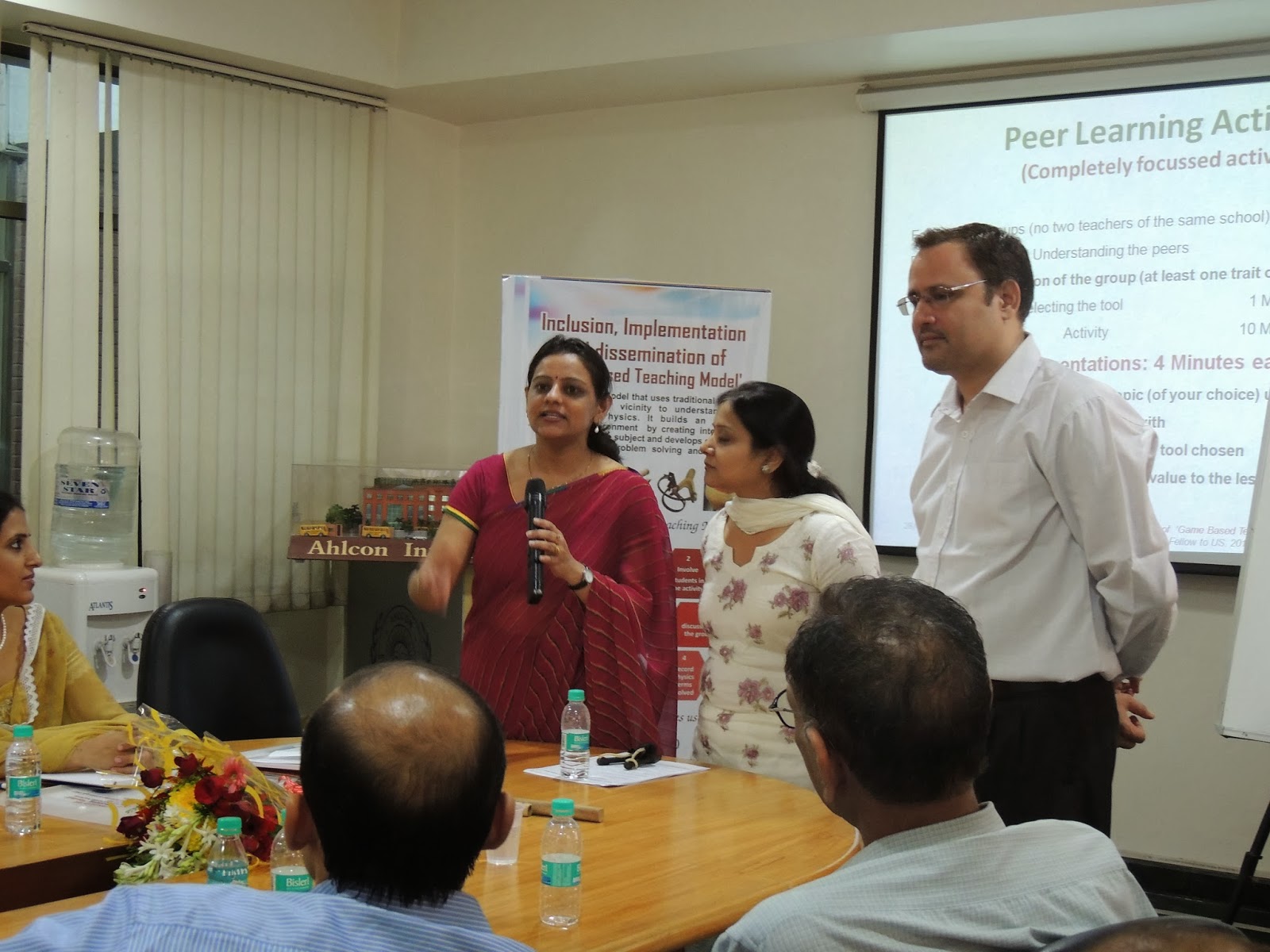
‘Inclusion, Implementation and dissemination of ‘Game Based Teaching Model’
September 28, 2013
A
workshop ‘Inclusion, Implementation and
dissemination of ‘Game Based Teaching Model’ was organized at Ahlcon International
School on September 28, 2013 for Middle
and High School Teachers. Teachers from thirty schools from Delhi and NCR were
invited to participate in this interactive event. It was an endeavor as a part of Alumni Grant
Activities of Fulbright DAT Scholarship of S C Joshi which was sponsored by
Institute of International Education, United States and hosted by Ahlcon
International School, Mayur Vihar, Phase – 1, Delhi. Prof V K Sud, an IIT’ian
who served at NASA for eight years was the chief guest of the workshop. Workshop
began with the preliminary note of Principal Ashok K Pandey and proceeded
further with the key note address of the chief guest. A website
gamebasedteachingmodel.com on ‘Game Based Teaching Model’ was launched by the
distinguished guests. Ms. Sangita Maliwal, Vice – Principal of the school was
also present in the workshop. Hands-on session was taken by Mr. S C Joshi on
peer learning. Teacher participants from different schools were able to prepare
lesson plans and presented them through microteaching.
Following were the focus areas of the workshop:
1.
Sharing Game based teaching model.
2.
Exchange of ideas to develop and promote
activity based learning material.
3.
Brainstorming session on developing
course (resource) material on “GBTM’.
4.
Gathering Inputs of academics (Sharing
teaching styles through Peer Teaching Learning)
5.
Interactive panel discussion.
Workshop was concluded through an
intensive panel discussion by distinguished
experts and vote of thanks of Ms. Sunita Rajiv.
I am grateful
to Mr. Ashok k Pandey, Principal, Ahlcon International School for his constant guidance
during the planning & execution and consistent support for hosting this activity in the
School without which it wouldn’t have been possible to organize this workshop.
I am also thankful to Department of State, United States for
providing financial assistance for this activity.
Subscribe to:
Posts (Atom)
-
Howdy (Official greeting of Texas A&M University)! It's completely a new beginning as a graduate student here at Texas A...
-
Threats to PPMCC (Factors affecting correlation): 1. Outliers: the data that stands out in the scatterplot does not contribute to ...