A workshop 'Learning
beyond boundaries: Exchanging activity based best lesson plans' was organized
as a part of Alumni grant activities of Fulbright Distinguished Awards in Teaching Program Scholar (India to the USA - 2012) S C Joshi, Head Learning Resource Center and Department of Physics, AIS in Ahlcon International School on 9th may 2015. This
workshop was exclusively organized for teachers teaching at middle and high
school levels (IX – XII) in East Delhi and NCR to share and enforce the best practices of flipping classrooms through various means at K-12 level.
To work closely with the educational leaders and academics from local schools to help them in developing instructional techniques of flipping classrooms using games into their teaching and to educate them more about use of traditional games as teaching tools in classrooms,
Exploring new ways of flipping classrooms
in Indian context, judicious use of technology for flipping classrooms, exchanging
ideas on flipping instructions using games and toys and on developing activity
based course material for high school students and studying efficacy of technological
tools in flipping classrooms at K-12 level,
To organize
an event where teachers from my school and from neighbouring schools (around
Delhi and NCR) will get an opportunity to work together as a team and get
an exposure through presenting opportunities in the workshop,
To exchange
ideas on developing activities using games and toys and to collect their
responses on the same through direct exchanges,
To develop
activity based course material for Indian middle and high school students
particularly from economical weaker sections,
To share
the outcomes of 2013 Alumni grant activities and latest developments in
implementing games in teaching,
Disseminating
my project work done during DAT grant to the students and teachers
especially from underserved population,
Studying
efficacy of traditional games and models as low cost pedagogical tools in
designing project based science curriculum,
Exploring
new ways of using games in science teaching and future possibilities of
disseminating ‘Game Based Teaching Model.’
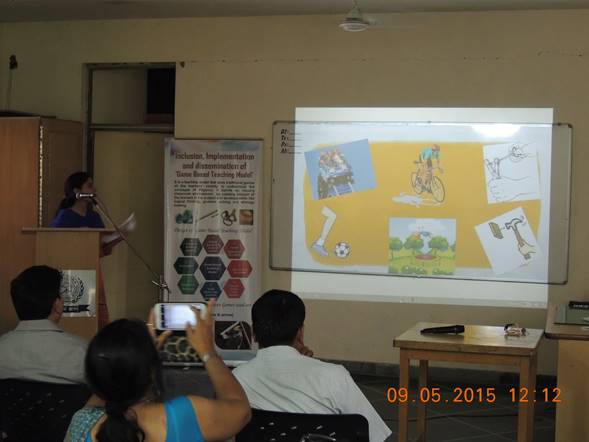
Teachers from thirty two schools were invited to participate in this event from which nine presentations were made by the teachers from AIS and other schools using online technological tools and other game based tools. Here, it is noteworthy that the presentations were supported by technological and game tools and consisted a lesson plan based on the topics covered in the academic curriculum of the schools.
Focus Areas of the Workshop were:
Teachers from thirty two schools were invited to participate in this event from which nine presentations were made by the teachers from AIS and other schools using online technological tools and other game based tools. Here, it is noteworthy that the presentations were supported by technological and game tools and consisted a lesson plan based on the topics covered in the academic curriculum of the schools.
The
distinctiveness of the workshop lied in the fact that teachers used new, different
and creative online technological tools such as toondoo, powtoon, popplet and
prezi to put forth their presentations and also incorporated several hands-on
–activities using low cost teaching aids that proved to be effective
pedagogical means. The chief guest of the day was Dr. Suraj Prakash
(Director, Bal Bharti Public School Training Center, Pitampura, Delhi), an
eminent educationist and a national awardee for his immense creative
contributions to the field of physics and education. Two students from the host
school also presented lesson plans on the topic of evolution and digestion
using the tech tools of popplet and toondoo.
The workshop concluded with the learned
words from the principal Mr. Ashok .K. Pandey inspiring the teachers to excel in
their respective fields. Ms. Sangital Maliwal, Vice-Principal, AIS and Mr.
Puneet Duggal, Incharge Senior School, AIS were also present in the workshop. In
totality, the event turned out to be quite successful and the participants took
along with them unfathomable knowledge and immeasurable confidence in using
today’s tech tools to educate the digital natives of tomorrow.




I am grateful to Mr. Ashok k Pandey, Principal, Ahlcon International School for his constant guidance during planning & execution and consistent support for hosting this activity in the School without which it wouldn't have been possible to organize this workshop. Financial assistance (Fulbright Alumni Grant) from Department of State, United States is deeply acknowledged.